Subject Guide – Labor
INTRODUCTION
During the 20th century, Jews played a key role in the American labor movement. The Jewish labor movement was invigorated by the mass immigration of Eastern Europe Jews between 1880 and 1920, many of whom were socialists or Bundists from pre-revolution Russia. Jews created their own labor unions and labor-centric mutual aid societies including the United Hebrew Trades and Workmen’s Circle (later renamed the Worker’s Circle). The Jewish Community Relations Council (JCRC, est. 1944) advocated for labor rights and worked with various labor organizations, including the Jewish Labor Committee, the Jewish National Workers Alliance, and Worker’s Circle. Jewish activists also took on prominent roles in non-Jewish labor organizations. Examples represented in the JHC collections include National War Labor Board Mediator Rabbi Albert I. Gordon (1903-1968) and garment worker trade unionist Sarah Wernon Sloan (1888-1987).
To view all collections in the JHC Archives related to this subject, click on the link below.
Materials
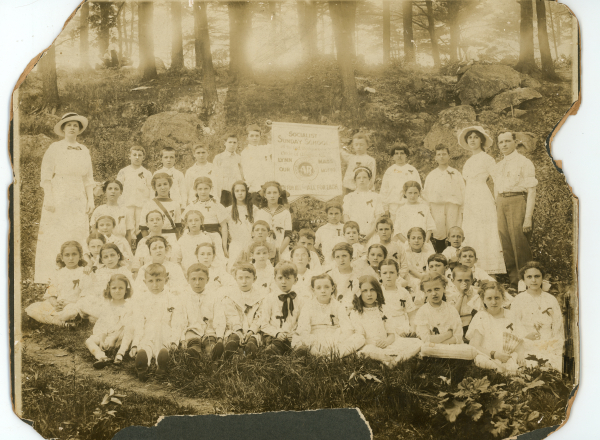
Worker’s Circle Socialist Sunday School, Lynn, MA, c1900s.
Created to provide mutual aid and education, The Workmen's Circle (later renamed The Worker’s Circle in the 2000s), was established in New York in 1900, expanding to Boston by 1903. The Workmen’s Circle provided Jewish education from childhood forward, running Sunday Schools and summer camps for communities with significant Jewish populations. Their motto, “Each for All, All for Each” reflects the progressive, socialist nature of the instruction and the broader organization.
Jewish Community of Peabody (Mass.) Records (I-581), Box 1, Folder 34
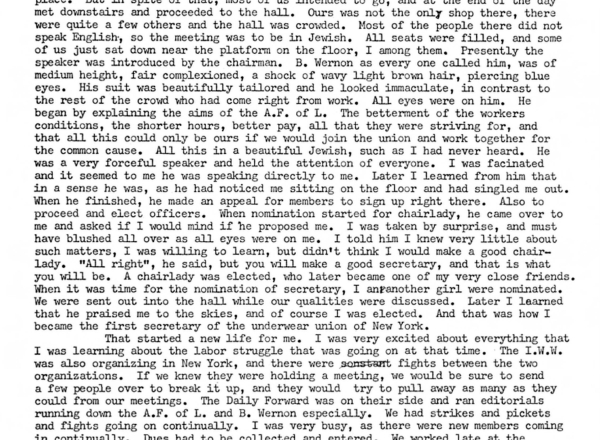
Sara Wernon Sloan memoir recalling her involvement with the Industrial Workers of the World (IWW) union, 1974.
Born in 1888 in Odessa, Sara (Buminowitz) Wernon Sloan immigrated to the United States at the age of ten with her mother and siblings. Her memoir recounts her time as a garment worker on the Lower East Side of New York City and involvement with Industrial Workers of the World (IWW) labor organizing. She was elected secretary of the union of underwear garment workers and met her first husband, American Federation of Labor (AFL) organizer Ben Wernon, through the labor movement. She lived and worked throughout New England, including owning a candy and dry goods store on Revere Beach.
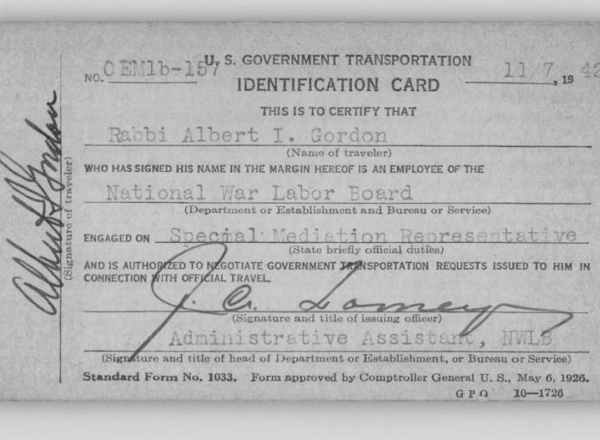
Rabbi Albert Gordon National War Labor Board ID Card, 1942.
During the Second World War, sociologist and author Rabbi Albert Gordon (1903–1968) served as a special mediation representative for the National War Labor Board, an agency dedicated to peacefully resolving labor disputes to maintain industrial production, efficiency and worker satisfaction. He then became a labor arbitrator for more than 20 industries. “I worked very hard at arbitration,” he is quoted as saying in a New York Times obituary. “What could be more satisfying than to develop peaceful and harmonious relations between people?” Gordon wrote and spoke extensively on Jewish life in American and the importance of Jewish education, and served as Rabbi of Temple Emanuel in Newton, MA for nearly two decades.
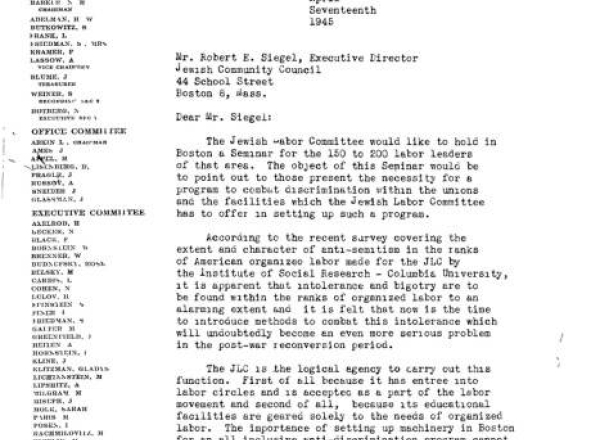
Jewish Labor Committee memo regarding a seminar for area labor leaders, 1945.
The Jewish Community Relations Council of Greater Boston (JCRC), a coalition founded in the 1940s to address rising antisemitism, regularly advocated for equitable labor practices. In September 1945, The Jewish Labor Committee of the JCRC held a seminar convening upwards of 150 local labor organizers to address discrimination within unions and consider what could be done to combat intolerance, thought to potentially “become an even more serious problem in the post-war reconversion period.”
Jewish Community Relations Council of Greater Boston Records (I-123 and I-123A), Box 34, Folder 1.
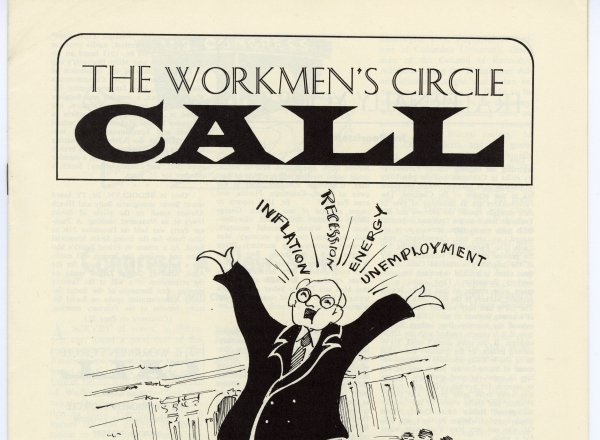
Cover of the Workmen’s Circle Newsletter The Call, March 1975.
Created to provide mutual aid and education, The Workmen's Circle (later renamed The Worker’s Circle in the 2000s), was established in New York in 1900, expanding to Boston by 1903. In addition to promoting Jewish life and education, The Workmen’s Circle was closely tied to the American labor movement and instrumental to the establishment of the Jewish Labor Committee in 1934. Its newsletter, The Call, regularly covered politics and labor issues.
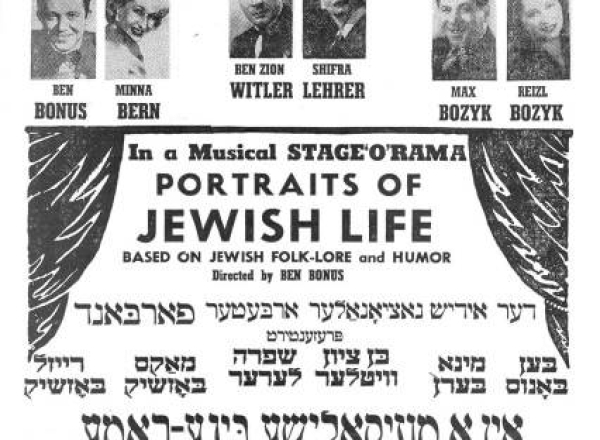
Flyer for Farband Labor Zionist Order concert in English and Yiddish, 1957.
The Farband Labor Zionist Order was a Jewish fraternal organization founded in 1910. Initially known as the Jewish National Workers’ Alliance, it was involved in the defense of labor rights from its start. Eventually developing branches across the United States and Canada, it functioned as a mutual aid society aligned with the Socialist and Zionist political party Poale Zion. Among the organization’s prominent endeavors were its yearly fundraising concerts that were open to the general public, showcasing talents in Yiddish drama and music.
Farband Labor Zionist Order (Boston, Mass.) Records (I-534), Box 1, Folder 2.