Subject Guide – Immigration
INTRODUCTION
The history of American Jewish immigration begins in September 1654 when 23 Jewish men, women, and children arrived in New Amsterdam, now New York City. Historians have identified three periods of Jewish immigration to the United States: Sephardic (beginning in 1654); German (beginning in the 1840s); and Eastern European (beginning in the 1880s). The majority of JHC collections come from the Eastern European period of immigration. Between 1880 and 1924, when the United States’ Johnson-Reed Act enacted restrictive immigration quotas, nearly three million Jews made their way from Eastern Europe to America, fleeing poverty, war, discrimination and violent antisemitic pogroms. Materials in the JHC’s collections help reveal the journeys and lived realities of immigrant communities. Collections also focus on advocacy including the Hebrew Immigrant Aid Society (HIAS) chartered in 1904, responses to the plight of refugees from Nazi-occupied Europe, and the Soviet Jewry movement in the United States, when multiple Jewish organizations advocated for the rights of Soviet Jews to immigrate to the U.S. and Israel.
To view all collections in the JHC Archives related to this subject, click on the link below.
Materials
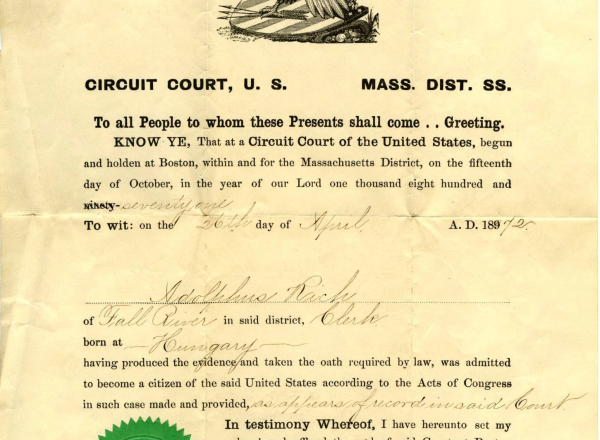
Certificate of Citizenship of Adolphus Strassman, 1891.
Born in Ungvár, Hungary in 1848, Adolphus Strassman (1848–1923) immigrated to the United States in 1857, where his family settled in Fall River, MA. At fifteen, he lied about his to enlist in the Union Army. He served on the front lines of the American Civil War as a Private in the 2nd Regiment of the Massachusetts Volunteer Heavy Artillery before being honorably discharged in September 1865. He returned home to Fall River and became an American citizen in 1872, receiving this certificate of in 1891.
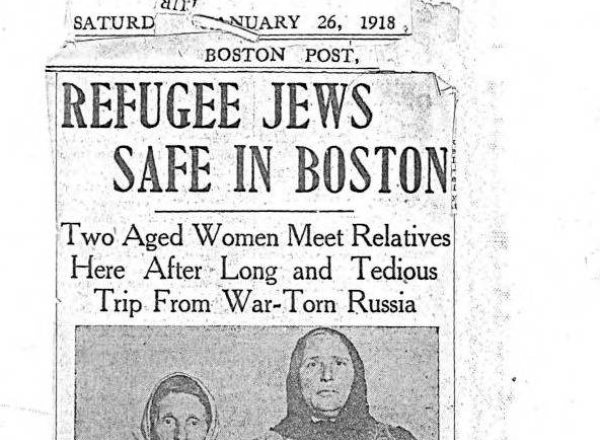
Boston Post newspaper article on Russian Jewish refugees, 1918.
This clipping is one of many articles on Jewish immigration saved by writer, speaker, and advocate Abraham Alpert (1873–1939), a Lithuanian immigrant who helped found the Boston Hebrew Immigrant Aid Society (HIAS), aiding over 2,000 immigrants in receiving citizenship.
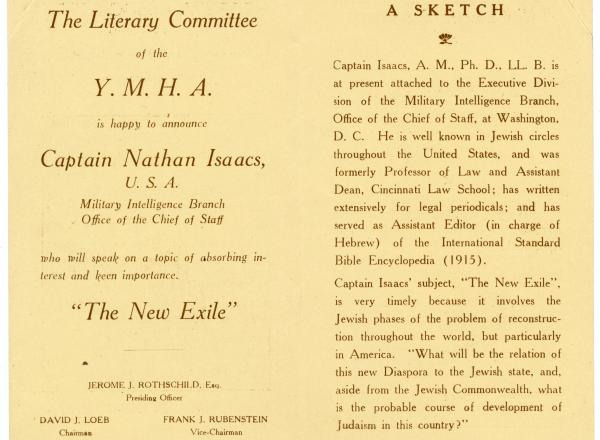
Nathan T. Isaacs lecture for the Young Men’s Hebrew Association of Philadelphia on “The New Exile,” 1919.
Nathan Isascs (1886–1941) was a prominent legal scholar and professor of law. During World War I, he served in the Army as a Captain of military intelligence. Throughout his career, he lectured regularly on numerous topics including the Jewish diaspora and American Jewry.
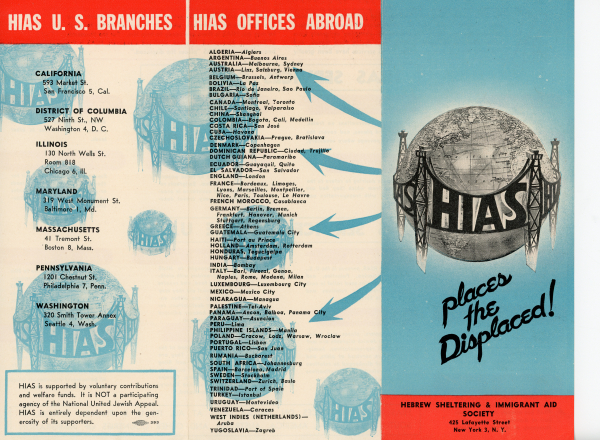
List of U.S. and international offices of the Hebrew Immigrant Aid Society, circa1940s.
The Hebrew Immigrant Aid Society (HIAS) was founded in New York City in the 1880s by the Russian Jewish community of New York in response to the influx of Russian Jewish immigrants fleeing the pogroms in the Pale of Settlement in Russia and Eastern Europe. The Boston office of HIAS, chartered in 1904, aided thousands of immigrants providing shelter and social services; ensuring access to religious services and kosher food; assisting immigrants with finding employment and schools and, especially during World War II, working to arrange sponsorship and safe passage.
Hebrew Immigrant Aid Society Boston Port Records (I-96), Box 220, Folder 1
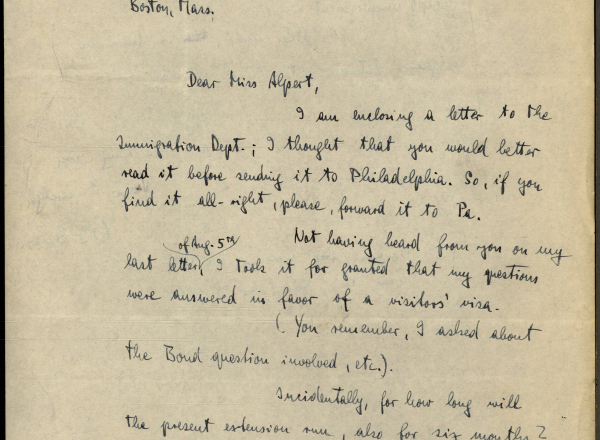
Letter from Werner Gans to the Boston Hebrew Immigrant Aid Society (HIAS) Executive Secretary Helen Alpert inquiring about his visa, 1943.
This letter is from an extensive collection of case files for immigrants who received assistance through the Boston office of the Hebrew Immigrant Aid Society. Helen Alpert, daughter of Boston HIAS founder Abraham Alpert’s daughter, was Executive Director and handled a high volume of correspondence and cases like this one. Werner Gans, a native of Germany, came to the U.S. on a student visa in 1939 and began studying music at Malkin Conservatory of Music in Boston. In 1941, he applied to the German consul in Boston to renew his passport, and the consul instead confiscated his passport on the grounds that he was no longer a citizen due to the law depriving Jews of German citizenship. Despite his lack of a passport, Helen Alpert was able to assist Gans with adjusting his immigration status so that he could continue his studies in the U.S.
Hebrew Immigrant Aid Society Boston Port Records (I-96), Box 190, Folder 27
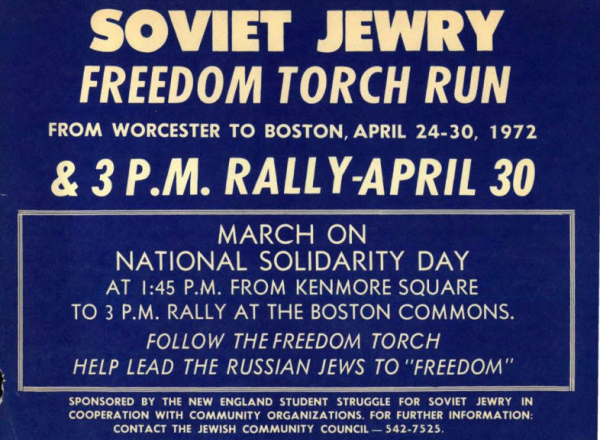
New England Student Struggle for Soviet Jewry event and rally poster, 1972.
The Student Struggle for Soviet Jewry was a grassroots movement that emerged in April 1964 on college campuses. Students concerned with the plight of Soviet Jews held rallies such as this one pressuring U.S. officials to condemn the Soviet government’s treatment of Soviet Jewry.
New England Student Struggle for Soviet Jewry Records (I-237), Box 1, Folder 2